 Toon Theology
Optional, never imposed
Passover, the feasts, the food laws, tzitzit on the corners of a garment: some believers keep them and some do not. Seventeen Torah practices sit in a category of their own. They may be kept freely. They may never be required.
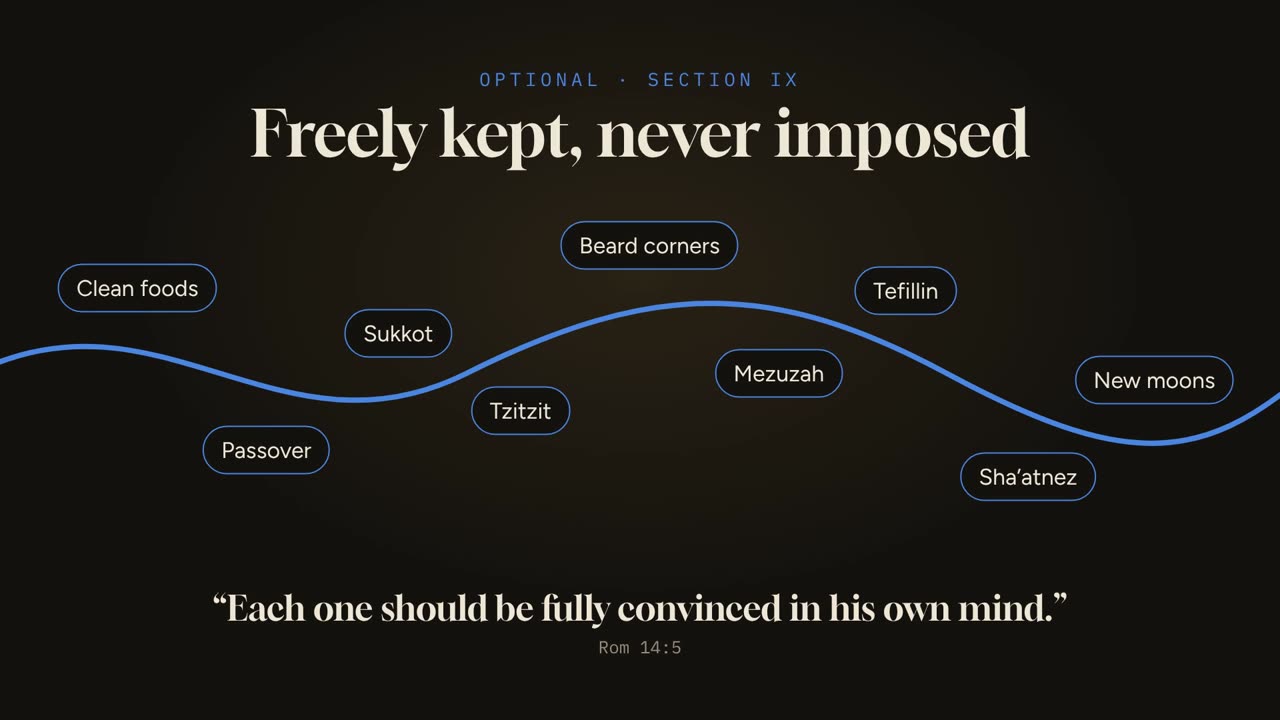
These practices were not removed by the filters as particular, priestly or penal. They were given to Israel as signs, and the New Testament treats them as shadows whose substance is Christ (Colossians 2:16–17). So they no longer bind. But nothing in the New Testament forbids them either. Jesus kept the feasts; Paul kept a vow and had Timothy circumcised (Acts 16:3; 21:23–26). Many Messianic and Torah-observant believers keep them today as devotion and as identification with Israel's Messiah.
The list includes a seventh-day Sabbath with traditional practice, Passover and the feasts, the new moons, the food laws, tzitzit, mezuzah and tefillin, the corners of the beard, and leaving the edges of a field for the poor.
Paul's rule for all of them is the same, and it cuts both ways. The one who keeps a day keeps it to the Lord; the one who does not, does not (Romans 14:5–6). Neither may judge the other. A believer who keeps the feasts may not treat one who doesn't as second-class, and a believer who doesn't may not treat one who does as legalistic.
That is the line the filters draw: freely kept, never imposed.
For reflection
- Romans 14:1–6 — "Let every man be fully persuaded in his own mind"
- Colossians 2:16–17 — a shadow of things to come; the body is of Christ
- Galatians 5:1–6 — where a practice becomes a requirement, Paul draws a hard line
- Acts 21:20–26 — Paul keeping the Law among Jewish believers
Over to you
If you keep one of these, why? And if you don't, how do you regard those who do?