 Toon Theology
Penalty removed, command stands
Leviticus 20:10 sentences an adulterer to death. No Christian carries out that sentence. Does that mean the command against adultery has gone too?
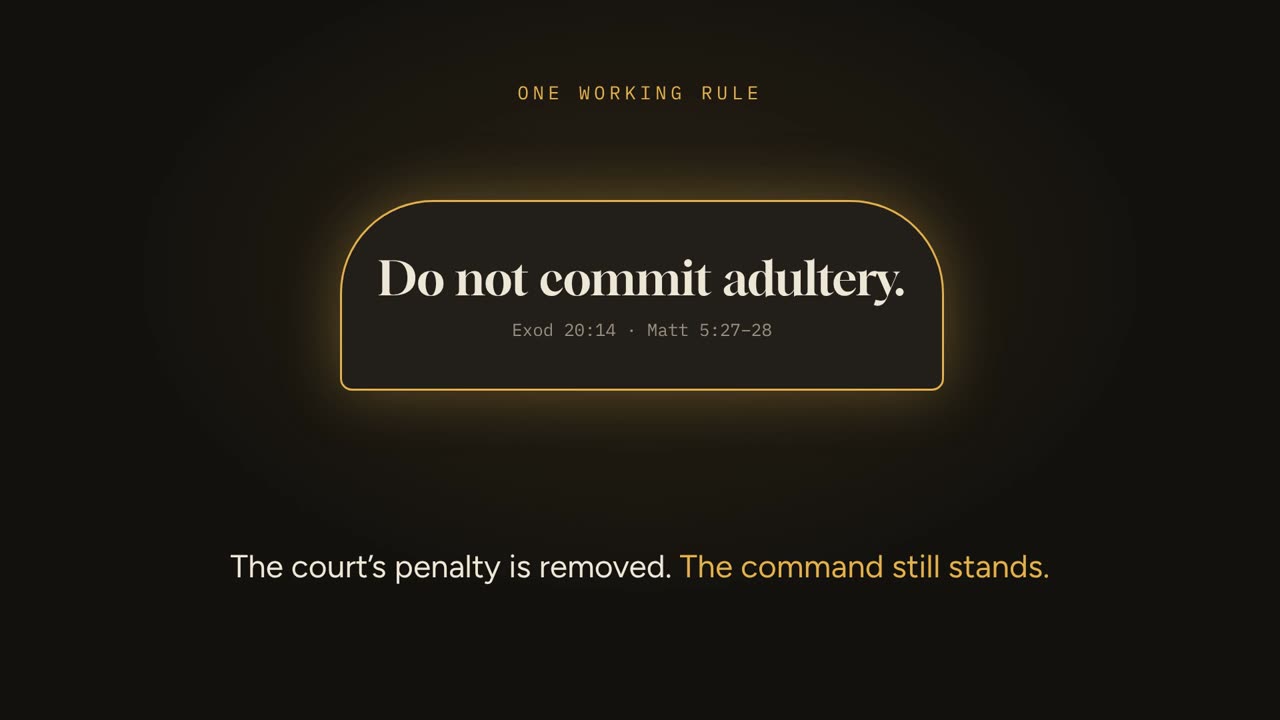
No. The Law often attaches two things to one wrong: a command addressed to every person ("You shall not commit adultery", Exodus 20:14) and a penalty addressed to the courts (Leviticus 20:10). The penalty was never the individual's to carry out. It belonged to judges and elders, in the land, under Israel's covenant.
So when the penalty is set aside, the command is not. Jesus did not lower the command on adultery; he raised it, to include the lustful look (Matthew 5:27–28). And when he met a woman caught in adultery, he declined to carry out the sentence, and then told her, "Go, and sin no more" (John 8:11). Both halves are in that one sentence.
The same pattern runs right through the Law. The sentence on mediums (Leviticus 20:27) is removed; the prohibition on divination stands. The judge's "eye for an eye" (Exodus 21:24) is removed; Jesus turns it into a personal command not to retaliate at all (Matthew 5:38–42).
The rule of thumb: ask who a sentence is addressed to. If it is addressed to a court, it is not yours to carry out. If it is addressed to you, it probably still is.
For reflection
- Exodus 20:14; Leviticus 20:10 — the command and the sentence, in two different places
- Matthew 5:27–28 — the command raised, not lowered
- John 8:1–11 — "Neither do I condemn thee: go, and sin no more"
- Romans 13:1–4 — who now bears the sword
Over to you
Is there a command you have quietly set aside because you knew its penalty no longer applied?